
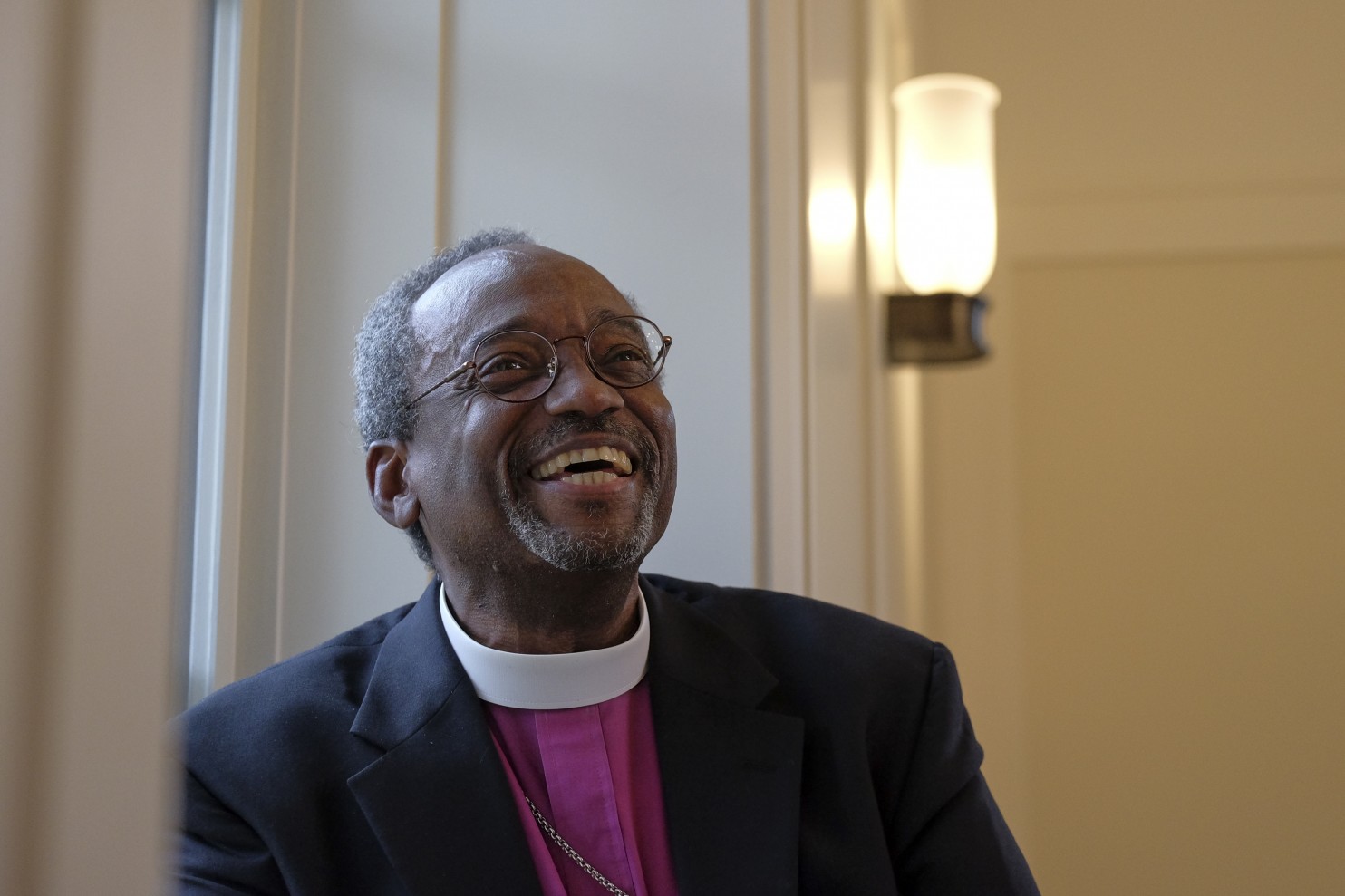
The invitation from the couple to Curry to preach at the service is a departure from tradition for British royal weddings. While previous royal weddings have involved clergy from other Christian churches saying prayers for the couple, sermons are usually given by senior Church of England clergy. The service will be televised around the world, and it is likely that the presiding bishop, who refers to himself as the CEO of the Episcopal Church – the chief evangelism officer – won’t resist the opportunity to talk about what he calls the Jesus Movement.

“The love that has brought and will bind Prince Harry and Ms Meghan Markle together has its source and origin in God, and is the key to life and happiness,” Curry said. “And so we celebrate and pray for them today.”
Prince Harry was born on Sept. 15, 1984 and was baptized at St. George’s Chapel, Windsor, three months later. After completing his formal education, he spent a gap year in Australia and South Africa before training for military service. He served with the British Army in Afghanistan as an officer in the Royal Horse Guards and 1st Dragoons of the Household Cavalry, in the U.S.-led operation to remove the Taliban from power following the September 11 terror attacks in New York and Washington. His service in Afghanistan came to an end after his presence there was revealed by an Australian magazine; but he returned there a few years later in a deployment with the Army Air Corps. In 2014, he launched the Invictus Games for injured ex-service personnel; and is patron of a number of organizations, including the HALO Trust, which is working to remove mines from Qasr el Yahud – the site on the west bank of the River Jordan at the traditional site of the baptism of Jesus.
Meghan Markle was born on Aug. 4, 1981 in Los Angeles, California. Her parents, Doria Ragland and Thomas Markle, divorced when she was six years old. In her acting career, she has appeared in a number of roles, including in the films Get Him to the Greek, Remember Me, and Horrible Bosses. But she is best known her portrayal of the character Rachel Zane in the hit U.S.-legal drama series Suits. Her character, a paralegal who trained to become an attorney, was the love interest of phoney-lawyer Mike Ross. Markle married Trevor Engelson in 2011; but the couple divorced in 2013, long before Markle met Prince Harry.
The couple have met Archbishop Justin Welby on a number of occasions as part of the preparations for the wedding; and Markle asked Welby to baptize her. It has been widely reported that she was baptized and confirmed by Welby at St. James’ Palace in London in March.
“It was very special,” Welby told ITV News. “It was beautiful, sincere and very moving. It was a great privilege. . . You know at the heart of it is two people who have fallen in love with each other, who are committing their lives to each other with the most beautiful words and profound thoughts, who do it in the presence of God.”
Previous royal weddings have involved a range of preachers. When Queen Elizabeth married Prince Philip in Westminster Abbey in November 1947, the service was conducted by the Dean of Westminster, Alan Don, while the wedding itself was officiated by Archbishop of Canterbury Geoffrey Fisher. The sermon was preached by Archbishop of York Cyril Garbett.
Prince Harry’s mother and father, Prince Charles and Lady Diana Spencer, took the unusual decision of marrying at London’s St. Paul’s Cathedral in 1981. They were married by Archbishop of Canterbury Robert Runcie, who also preached. In 2005, after Diana’s death, Prince Charles married his second wife Camilla, now Duchess of Cornwall, in a civil ceremony at Windsor Guildhall. This was followed by a Service of Prayer and Dedication at St George’s, Windsor, conducted by Archbishop Rowan Williams. There was no sermon in that service.
Prince Harry’s older brother, Prince William, married his wife Catherine at Westminster Abbey in 2011. The Dean of Westminster, John Hall, presided while Archbishop of Canterbury Rowan Williams conducted the wedding. London Bishop Richard Chartres, dean of Her Majesty’s Chapels Royal, preached the sermon.
St. George’s Chapel at Windsor Castle is located within the area of the Church of England’s Diocese of Oxford; but it is outside the jurisdiction of the diocesan bishop. It is one of a small number of Church of England churches known as Royal Peculiars – which means that it is under the direct control of the monarch, rather than the diocesan bishop or archbishop. Among the other Royal Peculiars are Westminster Abbey, the five chapels that make up the Chapels Royal, and the Chapel of St Mary Undercroft, in the Houses of Parliament.
Set Free By Truth is available for free downloading here.
Ash Wednesday: “Return to me with all your heart”; by Presiding Bishop Elizabeth Eaton, Evangelical Lutheran Church in America.
Lent 1: “An appeal to God for a good conscience”; by Archbishop Fred Hiltz, Anglican Church of Canada.
Lent 2: “Take up their cross and follow me”; by National Bishop Susan Johnson, Evangelical Lutheran Church in Canada.
Lent 3: “But we proclaim Christ crucified”; by Presiding Bishop Michael Curry, the Episcopal Church.
Lent 4: “The LORD sent fiery serpents among the people”; by Presiding Bishop Eaton.
Lent 5: “Purge me from my sin”; by Archbishop Hiltz.
Palm/Passion Sunday: “Hosanna!”; by Bishop Johnson.
Triduum: “Until he comes again”; by Presiding Bishop Curry.
Set Free By Truth can be downloaded for websites, bulletin inserts, church programs, and used as discussion points.
For more information, contact the Rev. Margaret Rose, mrose@episcopalchurch.org.
Presiding Bishop Michael B. Curry
2017 World Refugee Day Message
In the late 1930s, as the world was on the verge of being plunged into an apocalyptic Second World War, Episcopalians and the Episcopal Church gathered together and began work to resettle those who were refugees fleeing terror in Europe, helping to resettle families, helping to resettle young people, helping to resettle people in this country in safety and security.
Since the 1930s, Episcopalians have been involved in the work of resettling families and people who are refugees, some 80,000.
At that time, in the 1930s there was a poster that depicted Mary, the baby Jesus, and Joseph. Mary was on the donkey. They were clearly on a journey. They were fleeing Palestine. They were seeking to find safety in Egypt. They were refugees. The poster from the 1930s read, “In the name of these refugees, aid all refugees.”
In the name of Mary, Joseph and the Lord Jesus, aid all refugees today, for most of the refugees like the Holy Family themselves, are families, and most are children.
I invite you to observe June 20 as World Refugee Day to learn more about the crisis and to find ways that you can both pray and help in other ways.
God bless you, God keep you, and you keep the faith.
From Isaiah Chapter 9:
For unto us a child is born,
unto us a Son is given;
and the government shall be upon His shoulder;
and His name will be called Wonderful Counselor, Mighty God,
Everlasting Father, Prince of Peace.
These words of Isaiah are often seen as words that foretell and foreshadow the coming of Jesus of Nazareth, born of Mary. The truth is, these words befit Him because this child changed the world. This child changes lives. This child changes us.
I remember when our oldest daughter was a baby. My wife and I were young. We were footloose and fancy-free. It was just the two of us newlyweds, so if we wanted to go out to eat dinner, we went out to eat dinner. If we decided to go to a movie at the last minute, we just went. We actually felt like we had money back then. And we did have a little bit of discretionary income. We could pretty much do what we wanted to do, within reason, and we didn’t have to think too much about the consequences or impact of a spontaneous decision and what we had to do to make that happen.
And then, all of a sudden, this little, innocent human being, a little child, came into our lives, and literally gained control over our entire world. Before we could do anything else we had to think about, “Who’s going to keep the baby?” or “Is this a good time for us to go without the baby?” We soon learned that we were not in control of our lives anymore. Even our sleeping patterns became very different. We would stay awake when the baby was awake and we went to sleep when the baby went to sleep. Literally this child began to control our lives and the child didn’t even know she was doing it. And then we had a second one she did the exact same thing. And I’ve since learned that that’s what babies do. When they arrive they take over! And their parents begin to develop their lives around this child. To mold their entire lives around this precious needy baby.
Isaiah wrote, “Unto us a child is born, unto us a Son is given . . . and His name will be called Wonderful Counselor, Mighty God, Everlasting Father, Prince of Peace.” This child who was born of Mary changes everything. This child born in a manger, wrapped in swaddling clothes changes how we live. This child born to the sound of angels singing Gloria in excelcis deo — this child to whom the wise ones came from afar bearing gifts — this child, changed the way the entire world works.
And this Jesus, born into a world torn by strife and hatred and division and pain and poverty, this child is born anew wherever men and women say, “I’ll follow Him. I’ll follow Him as my Savior. I’ll follow Him as my Lord.”
When this child grew up, He said His reason for coming, again quoting Isaiah, from the 61st chapter, he said,
The spirit of the Lord is upon Me, because He has anointed Me to preach Good News to the poor, to proclaim release to the captives, the recovery of sight to the blind, to set at liberty all those who are oppressed, and to proclaim the acceptable year of the Lord.
This child, when He grew up, came to show us the way to live lives of love, lives of compassion, lives of goodness, lives of kindness, lives of justice. This child came to show us how to change the world. So this Christmas, make room for him to change us. This Christmas help us change the world. And make a new commitment, to go out from this day, to let this Christmas Day, be the first day of a new world.
God bless you. God keep you. Have a blessed Christmas. A Happy New Year. And go on out and change the world!
“The Episcopal Church Welcomes You,” is not just a slogan, it’s who we seek to be and the witness we seek to make, following the way of Jesus.
Episcopal Church Presiding Bishop and Primate Michael B. Curry has issued the following statement:
Last week I shared what I pray was a reconciling post-election message to our church, reminding us that ‘we will all live together as fellow Americans, as citizens.’ Today I want to remind us that during moments of transition, during moments of tension, it is important to affirm our core identity and values as followers of Jesus in the Episcopal Anglican way.
Jesus once declared, in the language of the Hebrew prophets, that God’s “house shall be a house of prayer for all nations” (Mk 11:17). He invited and welcomed all who would follow saying, “come to me all who are weary and are carrying heavy burdens” (Mt. 11:28).
We therefore assert and we believe that “the Episcopal Church welcomes you” – all of you, not as merely a church slogan, but as a reflection of what we believe Jesus teaches us and at the core of the movement he began in the first century. The Episcopal Church welcomes all. All of us!
As the Episcopal branch of the Jesus Movement today, we Episcopalians are committed, as our Prayer Book teaches to honor the covenant and promises we made in Holy Baptism: To proclaim by word and example the Good News of God in Christ; To seek and serve Christ in all persons, loving our neighbor as ourselves; to strive for justice and peace among all people, and to respect the dignity of every human being.
As Christians, we believe that all humans are created in God’s image and equal before God – those who may be rejoicing as well as those who may be in sorrow.
As a Church, seeking to follow the way of Jesus, who taught us, “you shall love your neighbor as yourself,” (Mt. 22:39) and to “do to others as you would have them do to you” (Mt. 7:12), we maintain our longstanding commitment to support and welcome refugees and immigrants, and to stand with those who live in our midst without documentation. We reaffirm that like all people LGBT persons are entitled to full civil rights and protection under the law. We reaffirm and renew the principles of inclusion and the protection of the civil rights of all persons with disabilities. We commit to the honor and dignity of women and speak out against sexual or gender-based violence. We express solidarity with and honor the Indigenous Peoples of the world. We affirm the right to freedom of religious expression and vibrant presence of different religious communities, especially our Muslim sisters and brothers. We acknowledge our responsibility in stewardship of creation and all that God has given into our hands. We do so because God is the Creator. We are all God’s children, created equally in God’s image. And if we are God’s children we are all brothers and sisters.
“The Episcopal Church Welcomes You,” is not just a slogan, it’s who we seek to be and the witness we seek to make, following the way of Jesus.
Presiding Bishop and Primate Michael B. Curry
The Episcopal Church
World Refugee Day – The Most Rev Michael B. Curry
In the late 1930s the world found itself on the verge of what became a terrible war. The Second World War. Millions of refugees were fleeing from Europe and fleeing around the world seeking asylum and safe haven.
In 1938 The Episcopal Church published this poster with the depiction of Mary, Joseph, and the infant Jesus, and it read, “In the name of these refugees,” referring to Mary, Joseph and Jesus, “Aid all refugees.”
The United Nations is now asking the peoples of the Earth, of all religious stripes and types, to once again come to the aid of those who are refugees.
I’m standing in front of the Isaiah Wall, based on the prophecy of the words of Isaiah, in the Second Chapter of his book, where the word says that one day, people will come to Mount Zion from all over the Earth, and they will hear God’s law, God’s way, and when people hear God’s way for life,
It is then that they will beat their swords into plowshares.
Their spears into pruning hooks.
It is then that the nations of the Earth will learn war no more.
Indeed, we must find a way to end war, but we must find a way to end the suffering of human beings who are forced from their homes. So I encourage you to support United Nations World Refugee Day. And do anything that you can do to bring an end to the unhappy lot for many so that they may find life as Jesus said, and have it more abundantly.
God bless you, God keep you, and you keep the faith.
The Most Rev. Michael B. Curry
Presiding Bishop and Primate
The Episcopal Church
Presiding Bishop Michael Curry calls for prayer for Ecuador

[April 18, 2016] Episcopal Church Presiding Bishop and Primate Michael B. Curry has called for prayers for the people and Dioceses of Ecuador following a devastating earthquake on April 17.
Two dioceses of the Episcopal Church are located in Ecuador:
• Litoral Ecuador led by Bishop Alfredo Morante.
• Central Ecuador led by Bishop Victor Scantlebury.
A magnitude-7.8 earthquake hit the South American country on Sunday, April 17. News reports indicate the death toll is over 200 people with 2500 injured.
The following is the message Presiding Bishop Curry sent to the bishops and people:
My dear brothers and sisters in Christ,
Please know that your brothers and sisters throughout the Episcopal Church are praying for you. We will be with you during this time and in the days ahead. You are not alone. May the love of God embrace and strengthen you.
Your brother in Christ,
+Michael B. Curry
Presiding Bishop and Primate
The Episcopal Church
“Bear one another’s burdens, and in this way you will fulfil the law of Christ.” Galatians 6:2
Presiding Bishop Michael Curry has called for a season of prayer for regions of the Anglican Communion which are experiencing violence and civil strife: “In this season of Resurrection, I call on everyone to pray for our brothers and sisters in areas where there is much burden and little hope.”

Beginning on April 3, the First Sunday of Easter, and continuing throughout the season, members of The Episcopal Church are asked to lift up in prayer parts of our world experiencing extreme violence and unrest. This is an opportunity to learn more about what the churches in these regions are doing to be sources of support and hope. This Easter, we will focus on Burundi, Central America, the Democratic Republic of the Congo, the Middle East, Pakistan, and South Sudan.
Check back in the coming weeks for more information about each region.
Prayers from the Book of Common Prayer for your use:
Eternal God, in whose perfect kingdom no sword is drawn but the sword of righteousness, no strength known but the strength of love: So mightily spread abroad your Spirit, that all peoples may be gathered under the banner of the Prince of Peace, as children of one Father; to whom be dominion and glory, now and for ever. Amen. (Prayer for Peace, p. 815)
Almighty God our heavenly Father, guide the nations of the world into the way of justice and truth, and establish among them that peace which is the fruit of righteousness, that they may become the kingdom of our Lord and Savior Jesus Christ. Amen. (Prayer for Peace Among the Nations, p. 816)
O God, you have bound us together in a common life. Help us, in the midst of our struggles for justice and truth, to confront one another without hatred or bitterness, and to work together with mutual forbearance and respect; through Jesus Christ our Lord. Amen. (Peace in Times of Conflict, p. 824)
“This is not a fairy tale.”
March 23, 2016
“This world does not need another fairy tale,” Episcopal Church Presiding Bishop and Primate Michael Curry said in his Easter 2016 Message. “This week’s story of crucifixion and resurrection is not a fairy tale.”
The following is the text of the Presiding Bishop’s Easter 2016 Message:
I actually love fairy tales and I used to enjoy reading them to our children when they were young and little. Now to be sure those were the more sanitized fairy tales but there was something good about them, a way of confronting what was tough in life with genuine hope. But they were fairy tales.
This week called Holy Week, the remembrance of Jesus entering Jerusalem and offering His life in the ultimate act of sacrificial love. Good Friday, the experience of betrayal, the experience of friends abandoning you, the experience of injustice and wrong, criminal self-centered conspiracies. And then beyond that Holy Week, the resurrection from the dead. This is not a fairy tale.
The truth is even as we speak this Holy Week, we do so not only in the shadow of the cross but we do so in the shadow of those who have been killed in Brussels, of those who have been wounded and maimed, of those who weep and mourn. And of a world mourning, and not too sure how to move forward. And this world does not need another fairy tale. This week’s story of crucifixion and resurrection is not a fairy tale.
Some years ago in the last century George McLeod, the founder of the Iona Community, had fought in the First World War, a war that he came to realize was fought for no good reason. He eventually became ordained, and founded the Iona Community, and at one point he said this about this faith that we hold as followers of Jesus:
I simply argue that the cross be raised again at the centre of the marketplace as well as on the steeple of the church. I am recovering the claim that Jesus was not crucified in a cathedral between two candles, but on a cross between two thieves, on the town garbage dump, at a crossroads so cosmopolitan that they had to write his title in Hebrew, Latin and Greek. It was the kind of place where cynics talk smut, thieves curse, soldiers gamble. That’s where he died. And that’s where we as Christians ought to be and what we as Christians ought to be about.
This week called Holy, the season called Easter, the remembrance of death and the realization of resurrection, this is not a fairy tale, but the revelation of ultimate reality. Now the truth is it’s easy to dismiss or discount whether by conscious conviction or by unconscious resignation to dismiss this as naïve, nice, but naïve. It’s easy to dismiss it whether consciously or unconsciously as a great hope, a wonderful ideal, but not realistic in a world like this. Maybe, parts of us I suspect wonder, maybe the strong do survive, maybe might does make right, maybe you better look out for number one. I suspect we all share those feelings once in a while.
But, I have to ask myself a question. It’s not my question, it’s Dr. Phil’s, “How’s that workin’ out for ya?” How’s that workin’ out for the world? The truth is, the way the world very often operates is not working out. It’s not sustainable. It’s not the way to life. Jesus has shown us the way. He has shown us that unselfish, sacrificial love, love of God, and love of the other, is the way to life. That, my friends, is the ultimate reality. And that’s not a fairy tale.
When Jesus was executed, He was tried and convicted of crimes He never committed. He willingly gave His life. Not for Himself, but for others. And in so doing, He showed us what love looks like. That’s what we call the Way of the Cross. And that Way is the way of life and hope. And when He died, His closest followers feared that maybe the strong do survive. Maybe might does make right. And maybe we better look out for number one. ‘Cause maybe the world has won.
But three days later, something happened. Unexpected. Undreamed of. Unheralded. Three days later their world turned upside-down which is right-side up. God raised Him from the dead. And you could almost hear God thundering forth in that resurrection. Love, in the end, love wins! Love is the way! Trust me! Follow me! Believe in me! This resurrection is real! This is not a fairy tale!
So go forth into this world. Don’t be afraid. And don’t be ashamed to be people of love. And go forth into this world and help us to change it from the nightmare it often is into the dream that God intends.
A blessed Holy Week, a blessed Easter, and go forth into the world. Amen.
The Most Rev. Michael Curry
Presiding Bishop and Primate
The Episcopal Church
Presiding Bishop Curry calls for ‘remembering our sister and brother Christians in the Holy Land who maintain the faith which we hold so dear’
[Episcopal Church Office of Public Affairs press release] “Our journey as Episcopalians also includes remembering our sister and brother Christians in the Holy Land who maintain the faith which we hold so dear,” Presiding Bishop Michael Curry wrote to the clergy of The Episcopal Church. “Their witness is an inspiration.”
Presiding Bishop Curry wrote in the annual Good Friday letter to all congregations asking them to consider assistance for Jerusalem and the Middle East.
“As you know, each year, every bishop and congregation is encouraged by the Presiding Bishop to participate in the Good Friday Offering,” he wrote. “This tradition is decades old and is an important statement of our solidarity with the members of the four dioceses of the Province of Jerusalem and the Middle East. We have a Gospel imperative to be sure they know they are not forgotten behind the headlines or because of the distractions in our own lives.”
Funds collected from the Good Friday Offering are gathered and distributed to the Province of Jerusalem and the Middle East which includes the Dioceses of Jerusalem and Cyprus and the Gulf, all members of the Anglican Communion.
“We shall either learn to live together … or perish together as fools,” Presiding Bishop Michael Curry began a Feb. 8 address to members and guests of the National Press Club.
The words, spoken by the Rev. Martin Luther King Jr. during a 1964 speech in St. Louis, Missouri, serve as a defining quote for the 21st century, said Curry.
“The choice is ours, ‘chaos or community,’” said Curry, the latter words echoing King’s fourth and final book, “Where Do We Go from Here: Chaos or Community,” published in 1967. In the book, said Curry, it was evident that King was struggling with the future of the civil rights movement and how to lead a nation – potentially set on tearing itself apart – during a time of racial- and class-strife, and the Vietnam War.
Building on the theme, “the church’s role in creating a more inclusive society,” Curry shared his remarks with more than 30 people gathered in the Edward R. Murrow Room of the club’s headquarters.
A professional organization for journalists and communications professionals with more than 3,500 members, Curry spoke as part of the club’s regular Newsmaker series, or hour-long news conferences, in which congressmen, government officials, policy experts, organizational and influential leaders address members and respond to questions from the media. Former Presiding Bishop Katharine Jefferts Schori addressed the press club in 2008.
Curry’s invitation to speak came at the recommendation of Susan Hahn, a press club member and a member of Christ Church in nearby Alexandria, Virginia. Hahn attended the event along with other Episcopalians, including the Rt. Rev. Mariann Edgar Budde, bishop of the Diocese of Washington, and the Rt. Rev. Gene Robinson, former bishop of the Diocese of New Hampshire.
On Feb. 7, Curry preached at Washington National Cathedral during an afternoon Eucharist commemorating Absalom Jones, the first African-American to be ordained an Episcopal priest.
Curry told those gathered at the press club that he was surprised at his election as the first African-American presiding bishop and primate of the Episcopal Church during its triennial General Convention last June.
He said that his election wasn’t the only surprise, however, citing the Episcopal Church’s two mission priorities of evangelism and racial reconciliation adopted by that same General Convention.
“Evangelism and Episcopalian” are two words rarely heard together, said Curry, adding that “for the first time evangelism was put front and center for the Episcopal Church,” and that it had made a serious commitment to return to the work of racial reconciliation for the first time since the late 1960s, when John E. Hines was presiding bishop of the Episcopal Church.
“Those were two courageous acts, and I don’t think any of us really saw that coming either,” he said. “I suspect when you don’t see something like that coming that may well be a sign that some other variable is involved in the equation, which means the Holy Spirit has been messing with us…
“We came out of that convention with the Episcopal Church having made a commitment to what I call the Jesus Movement and a commitment to following in the way of Jesus of Nazareth, not exactly knowing how all of this is going to play out, but following in the way of Jesus of Nazareth which is the way of God’s love in this world. And doing it by a way of evangelism and a way that leads to racial reconciliation in our society and in our world.”
Curry said he is convinced that King’s 21st century call “to learn to live together as brothers and sisters, is tied up with the truth of this Jesus Movement and work of evangelism and racial reconciliation.”
Presiding Bishop Michael Curry addresses members and guests of the National Press Club on Feb. 8 in Washington, D.C., on the church’s role in creating a more inclusive society. Photo: Lynette Wilson/Episcopal News Service
As British Rabbi Jonathan Sacks points out in his book, “Not in God’s Name: Confronting Religious Violence,” religious extremism is happening in Judaism, Christianity and Islam, and that more moderate, centrists voices are missing from the conversation. And the west has largely turned away from its former Judeo-Christian values, instead turning to the idols of the self: the market, consumerism, individualism.
“The golden calf of the self has been raised by the children of Israel in the wilderness again,” said Curry in support of Sacks’ belief. “That golden calf, that idol of the self, may well be the most destructive reality in human society. Self-centeredness, selfishness, call it what you will, frankly is a cancer that can destroy us all and left unchecked will destroy the planet.”
Curry is encouraged by Pope Francis, he said, in his popularity and his actions toward including everyone; he is modeling a “way of being that is the exact opposite of that self-centered, self-destructiveness, and therein lies the hope.”
Jesus, said Curry, had it all figured out, as clearly stated in Matthew 22, that the law and the prophets hangs on loving God and loving neighbor.
“Religion is completely and totally meant to be about the love of God and the love of neighbor, and if it’s not about love, it’s not about God…”
King, said Curry, understood that love is the way to create “beloved community.”
“If I love God with all my heart and all my mind, there’s no room for self-interest,” said Curry.
For its part, the Episcopal Church putting evangelism and racial reconciliation front and center, is intentionally looking at how it will approach the work of loving God and neighbor both within and outside the Episcopal Church.
Curry spoke of evangelism and racial reconciliation in the context of the love of God and love of neighbor as a path to the “light of the world.”
Evangelism is not about bringing people to the Episcopal Church, but about bringing people into a “deeper, abiding relationship with God.”
“Evangelism is bringing us back to that God and bringing us back to each other and that’s the reconciliation, and when that happens we do not let children go to bed hungry; when that happens every child has an opportunity for an affordable and an excellent education; when that happens every human being is a child of God and endowed by God with certain inalienable rights to life, liberty and the pursuit of happiness; when that happens we will lay down our swords and shields by the riverside and study war no more.
“We will either learn to live together as brothers and sisters … or perish together as fools. But I’m not in this business because I believe we will perish. I’m in this business because we’re going to learn to live together, and the Episcopal Church is going to help lead the way ’cause we’re part of the Jesus Movement.”
— Lynette Wilson is an editor/reporter for the Episcopal News Service.
Before I say a word about our gathering here at the Primates Meeting, I just want to say a word of thank you to you for all of your prayers: your prayers for this meeting, your prayers for me personally, both here and in my earlier sickness. We are well, and God is God, and I thank you.
Let me say a word about the meeting.
This is not the outcome we expected, and while we are disappointed, it’s important to remember that the Anglican Communion is really not a matter of structure and organization. The Anglican Communion is a network of relationships that have been built on mission partnerships; relationships that are grounded in a common faith; relationships in companion diocese relationships; relationships with parish to parish across the world; relationships that are profoundly committed to serving and following the way of Jesus of Nazareth by helping the poorest of the poor, and helping this world to be a place where no child goes to bed hungry ever. That’s what the Anglican Communion is, and that Communion continues and moves forward.
This has been a disappointing time for many, and there will be heartache and pain for many, but it’s important to remember that we are still part of the Anglican Communion. We are the Episcopal Church, and we are part of the Jesus Movement, and that Movement goes on, and our work goes on. And the truth is, it may be part of our vocation to help the Communion and to help many others to grow in a direction where we can realize and live the love that God has for all of us, and we can one day be a Church and a Communion where all of God’s children are fully welcomed, where this is truly a house of prayer for all people. And maybe it’s a part of our vocation to help that to happen. And so we must claim that high calling; claim the high calling of love and faith; love even for those with whom we disagree, and then continue, and that we will do, and we will do it together.
We are part of the Jesus Movement, and the cause of God’s love in this world can never stop and will never be defeated.
God love you. God bless you. And you keep the faith. And we move forward.
Presiding Bishop and Primate thanks Episcopalians for their prayers
The Episcopal Church Office of Public Affairs press release] Presiding Bishop and Primate Michael B. Curry wishes to thank all Episcopalians and others for the generous outpouring of prayer and well wishes in response to his Dec. 6 announcement that he will be undergoing surgery.
That surgery, originally scheduled for Dec. 7, is now scheduled for Dec. 8. The postponement is to allow some aspirin he took on Dec. 6 the time needed to clear his system.
Presiding Bishop Curry was taken to the hospital Sunday, Dec. 6 after a visitation to Bruton Parish Church in Colonial Williamsburg, Virginia. A full recovery is expected.
Bishop Stacy Sauls, chief operating officer and the presiding bishop’s chief of staff, will be the celebrant and preacher at the Chapel of Christ Our Lord, 815 Second Ave., New York City, at 12:10 pm Eastern on Dec. 8. He will include the following prayer for Bishop Curry, and invites others, wherever they may be, to join.
Precious Lord, take our hands, lead us on, let us stand. Let us stand today that we might better praise you. Let us stand that we might better hear you. Let us stand that we might better see you in the face of our neighbor. Let us stand that we might better embrace those who need you today. Let us stand that we might better feed those who hunger today. Let us stand that we might better serve the needy today. Let us stand that we might better clothe the naked today. Let us stand that we might better walk to visit the sick and free the captives and proclaim the good news of salvation to the ends of the earth today and every day. Let us stand today, even though we know you are doing for us better things that we can ask or imagine, to seek your presence with Michael and among us. Strengthen him on this day of his surgery. Guide those who care for him on your behalf in the hospital. And bring us all together again in your way and in your time that we can live lives of gratitude and love from this day onward. It is your holy name that we pray. Amen.
(Inspired by Songs My Grandma Sang by Michael B. Curry)
Bishop Sauls noted that further information will be released by the presiding bishop’s office.


